How MENA E-commerce Stores Quietly Bleed Margin — and How to Stop Reactive Pricing
Your bestseller, priced 14% below you for three weeks — and you never noticed. That's the quiet cost of reactive pricing, and how MENA stores can stop the leak.
It usually happens on an ordinary Tuesday.
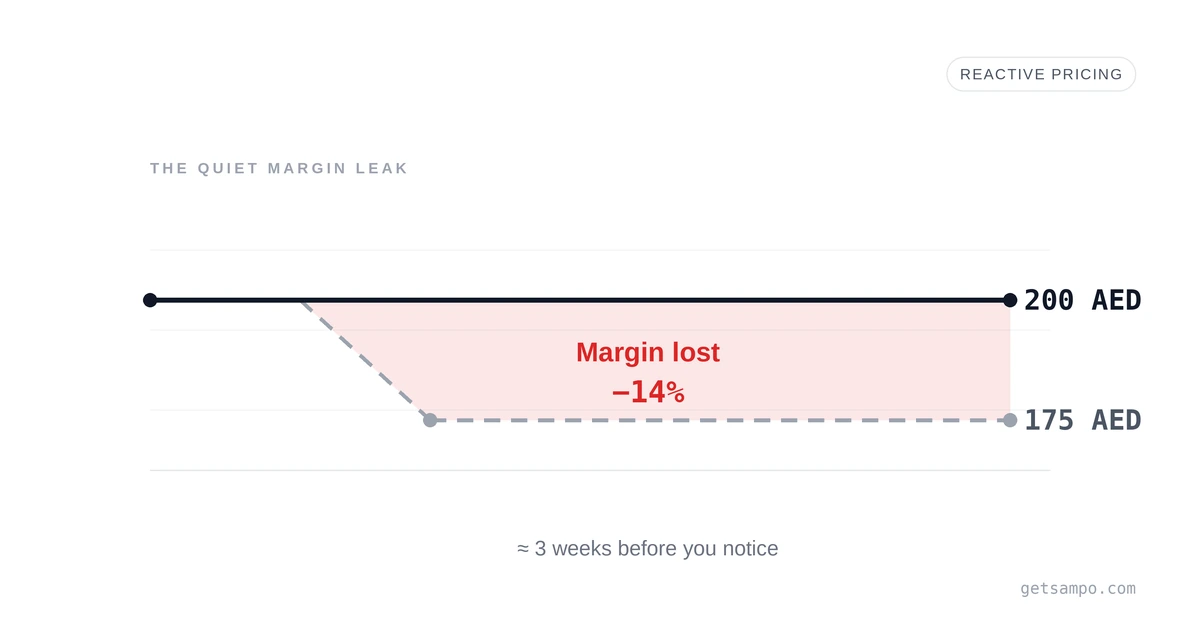
You open a competitor's product page to check something unrelated, and there it is: your best-selling product, priced 14% below yours. Not for an hour. Not since this morning. You dig into the data and realize the gap has been there for almost three weeks.
Now do the math across your catalog. If one SKU drifted that far without you noticing, how many of your other 300, or 3,000, or 30,000 products are sitting in the same blind spot right now?
This is the hidden cost of reactive pricing: finding out about a price problem after it has already cost you sales and margin. It rarely shows up as a single dramatic loss. It shows up as a slow leak that quietly drags down your numbers every single month. And without proper price monitoring in place, most ecommerce stores never see it happening at all.
What reactive pricing actually costs you
Margin loss from slow pricing comes in three forms, and most stores are losing money to at least two of them at the same time.
- You're overpriced, so you lose the sale. A price-sensitive shopper compares you to a competitor on Noon or a rival store, sees you're more expensive, and buys from them. You never even know the customer existed. This is the most expensive leak because it's invisible. There's no record of the sale you didn't make.
- You're underpriced, so you give margin away. The opposite problem, and just as common. A competitor raised their price last week and you never matched it. You're still selling at the old number, leaving real profit on the table on every order. The product still sells, so nothing looks wrong, which is exactly why this one goes unnoticed for so long.
- You react too slowly, so you're always a step behind. Even stores that do track competitors often check once a week, or whenever someone remembers. In a market where competitors reprice multiple times a day, a weekly check means you're working off stale data most of the time.
Here's a quick illustration. Say you sell a product for 200 AED at a 25% margin (50 AED profit per unit). A competitor quietly drops to 175 AED. Over three weeks you lose, conservatively, 40 sales to them. That's 2,000 AED of profit gone, from one product, in one blind spot, in one month. Multiply that across a catalog and the "small" leak becomes the difference between a good quarter and a flat one.
Why MENA makes this problem worse
Reactive pricing hurts everywhere, but the MENA e-commerce market has a few characteristics that turn a slow leak into a steady drain.
The selling calendar is unusually intense. Ramadan, Eid, White Friday, and the Saudi (KSA) and UAE National Day sales aren't minor blips. They're high-volume windows where competitors across the Gulf reprice aggressively and often, frequently using dynamic pricing of their own. Our own analysis of pricing during Ramadan and Eid al-Adha found price changes clustering into specific hours, with some retailers adjusting the same product multiple times in a single day. If you're checking prices weekly during a season like that, you're effectively flying blind.
Matching products across stores is also harder here than in most markets. Listings mix Arabic and English, brand names get transliterated (سامسونج and Samsung are the same brand), and the same product appears under slightly different titles on every site. For a store in Dubai or Riyadh tracking dozens of rivals, manual tracking in a spreadsheet falls apart fast when you can't even reliably tell which competitor listing matches which of your products.
And the marketplaces move quickly. Between Noon, Amazon.ae, and dozens of independent stores, the competitive set for any given product is large, active, and constantly shifting.
Why manual tracking can't keep up
The instinct, when you realize you're bleeding margin, is to assign someone to "keep an eye on competitor prices." It feels responsible. In practice it almost never works, for three reasons.
It doesn't scale. A person can manually check a few dozen products a day. They cannot check thousands every hour, which is the cadence the market actually moves at.
It's always out of date. By the time a manual check is logged into a spreadsheet, several competitors have already changed their prices again. You're making today's decisions on last week's data.
It breaks constantly. Anyone who has built a homemade scraper or tracker knows the pain: a competitor redesigns their site, the tool silently stops working, and you don't find out until weeks of bad data have already shaped your decisions.
The uncomfortable truth is that reactive pricing isn't a discipline problem you can fix by trying harder. It's a speed-and-scale problem, and humans with spreadsheets are on the wrong side of it. Closing the gap takes dedicated price monitoring software and automated repricing, not more willpower.
What proactive pricing looks like instead
Stopping the bleed means flipping the model: instead of discovering price problems after they cost you, you see them as they happen and decide deliberately. That comes down to three capabilities working together.
Continuous, accurate monitoring. You need to know what every relevant competitor is charging, refreshed often enough to matter, up to hourly rather than once a day. Crucially, the matching has to be accurate; tracking the wrong listing is worse than not tracking at all. This is where Sampo's competitor tracking is built for the region specifically: 99.95% matching accuracy that handles Arabic, transliterations, and mixed Arabic-English listings automatically, with self-healing scrapers that fix themselves when a competitor redesigns their site, so your data never silently goes stale.
Recommendations you can actually trust. Raw competitor data tells you what changed; it doesn't tell you what to do. The harder question is which price actually maximizes profit once you factor in your margin, stock, demand, and the season. Sampo's pricing recommendations analyze those signals and show the predicted profit impact before you apply a change, in plain language, with full transparency on the data behind each one.
Automation with guardrails. Once you trust the logic, the final step is letting it run so you're never the bottleneck again. Automated dynamic pricing reprices 24/7 within rules you set (margin floors, minimum and maximum prices, approval workflows) so you stay competitive around the clock without ever risking a sale below cost. This is also the difference between winning and losing a price war without racing to the bottom: you compete on the products where it counts and protect margin everywhere else.
A practical checklist to stop the bleed
Even before you adopt any tool, you can pressure-test how exposed your store is right now.
- Pick your top 20 SKUs by revenue and check them against your main competitors today. How many are mispriced, too high or too low? That ratio, applied across your catalog, is the size of your leak.
- Ask how old your pricing data is. If the honest answer is "a few days" or "whenever we last looked," you're making decisions on stale numbers.
- Separate your products into commodities and differentiated lines. Commodities need fast, competitive repricing; differentiated products need value-based pricing. (We break this framework down in The Strategic Pricing Framework Every E-commerce Store Needs.)
- Map your real competitive set per platform across Noon, Amazon.ae, Salla, Zid, and direct stores. You can't monitor what you haven't identified.
- Set hard guardrails before you automate anything. A margin floor and a minimum price mean speed never comes at the cost of selling below profit.
Still comparing tools? See how Sampo stacks up against Prisync and Price2Spy.
The bottom line
Reactive pricing rarely announces itself. There's no alarm when you lose a sale to a cheaper competitor, and no warning when you leave money on the table by selling too low. The damage is real, it's continuous, and for most MENA stores it's running in the background right now.
The fix isn't to watch competitors more anxiously. It's to stop relying on manual checks altogether and move to monitoring, recommendations, and automation that operate at the speed your market actually moves: every hour, across every SKU, in a way that's built for Arabic listings and the MENA selling calendar.
You don't have to guess how much you're losing. Get a free Market Report and see exactly where your prices sit against your competitors, or book a demo and watch Sampo find your first pricing opportunities within 24 hours of setup. Either way, the leak stops being invisible.