The Strategic Pricing Framework Every E-commerce Store Needs
When you're setting prices for your e-commerce store, you probably lean on one of two popular methods. The first is "cost-plus" pricing: you calculate your costs, add a standard markup, and you're done. The second is "competitor-based" pricing.
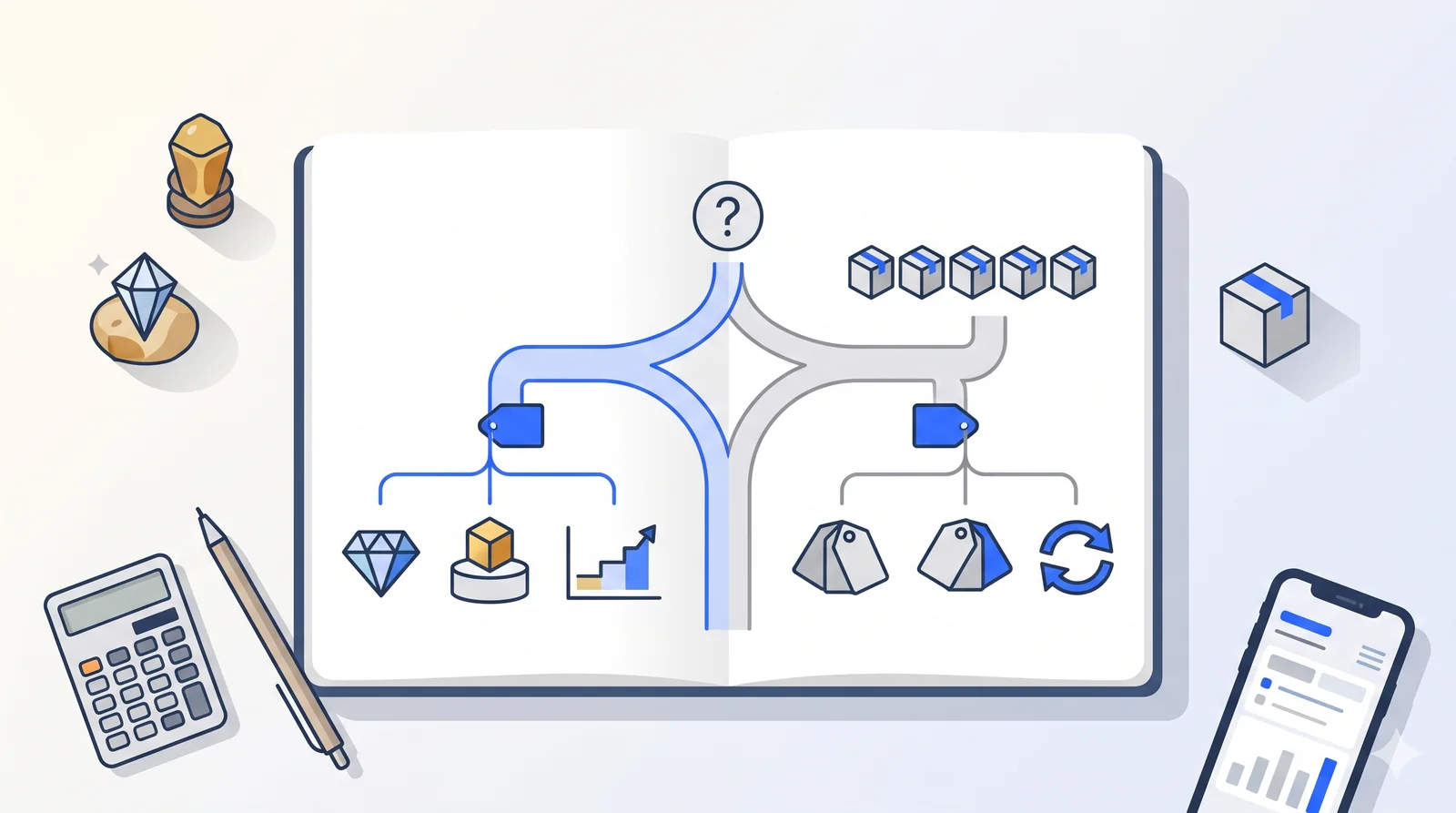
When you're setting prices for your e-commerce store, you probably lean on one of two popular methods.
The first is "cost-plus" pricing: you calculate your costs, add a standard markup, and you're done. The second is "competitor-based" pricing: you see what your rivals are charging and set your price somewhere nearby.
These methods are common because they're simple. They feel logical and safe. But they share a fundamental, profit-killing flaw: they are based entirely on your own costs or your competitors' decisions. They completely ignore the single most important variable in the equation: your customer.
If you want to move from simply covering costs to actively maximizing profit, you need a more strategic approach. Here is a simple but powerful framework that aligns your pricing with your business model and, most importantly, with the customer you serve.
The Foundational Question: Are Your Products Differentiated or Commodities?
Before you can price anything effectively, you must answer one foundational question: Are you selling differentiated products or commodities?
Your answer will dictate your entire pricing strategy.
A commodity is a product that is easily available from multiple sellers. Think of a specific model of Sony headphones, a popular brand of protein powder, or a standard iPhone charging cable. For the customer, these items are largely interchangeable. Because it's the exact same product everywhere, the primary deciding factor often becomes price and availability. A differentiated product, on the other hand, is unique to your brand. This could be a skincare product with your own proprietary formula, a line of custom-printed t-shirts, or a handmade leather wallet. It is difficult, if not impossible, for a customer to find an exact substitute. Its uniqueness comes from your design, your quality, or your brand story.
Once you've classified your products, you can apply the right strategy.
Strategy 1: The Playbook for Differentiated Products (Value-Based Pricing)
If you sell unique, differentiated products, pricing based on your costs or what a "similar" competitor charges is one of the biggest mistakes you can make. You are anchoring your price to an arbitrary number instead of the true perceived value you've created for your customer.
The correct strategy here is value-based pricing. The goal is to discover the highest price a customer is willing to pay.
(Price based on VALUE, not on COST.)
So, how do you find that number? You test.
A practical way to begin is with methodical, small price adjustments. For example, increase the price of a key product by 5% and carefully monitor the results for two weeks.
Crucially, you're not just watching the number of units sold. You need to analyze your total profit. It's incredibly common to see a small dip in sales volume but a significant increase in overall profitability because the margin on each sale is higher. You might sell 95 units instead of 100, but make far more money.
(Goal: Maximize Total Profit, not Unit Sales.)
While this manual testing is powerful, it can be slow and requires constant attention, especially if you have many unique products. That's why Sampo automates this process of value discovery. Our "Maximize Profitability" playbook systematically A/B tests small, gradual price increases. It constantly measures the impact on both conversion rates and total profit against the original price, intelligently testing higher until it finds the data-proven sweet spot for you. It automates the search for your most profitable price point.
Strategy 2: The Playbook for Commodities (Dynamic Pricing)
If you're selling commodities, the rules of the game are completely different. Your customer is highly price-sensitive, and the market is transparent. They can, and will, check prices elsewhere.
Instead of seeing this as a disadvantage, the winning strategy is to embrace it. You make competitive pricing a core part of your brand promise.
Don't just try to be the cheapest; build a public reputation for providing the best price, consistently. When you make a "Best Price Guarantee" a central part of your marketing, you attract the right kind of customer and remove their need to shop around.
But making that promise is easy. Keeping it is the hard part.
Manually tracking dozens of competitors across hundreds of products is an exhausting, inefficient, and ultimately impossible task. By the time you spot a change and adjust your price, the market has already moved on.
This is where dynamic pricing automation becomes your essential tool.
Tools in this category, like Sampo, automate the entire process of monitoring and repricing. You connect the software to your store and set your own rules. For instance, you can create a rule to "always be the lowest price by 1 SAR," while also setting a floor price to ensure you never sell at a loss.
This automation is what allows you to confidently make that "Best Price" promise. The software works for you 24/7, ensuring your brand promise holds true and allowing you to win in a competitive market at scale.
Your Strategic Path Forward
To recap the framework:
First, identify your product type. Are you offering a differentiated product or a commodity? If it's differentiated, focus on value-based pricing. Methodically test price increases to find the sweet spot that maximizes your total profit—a process that can be fully automated. If it's a commodity, build your brand around a promise of competitive value. Then, use dynamic pricing automation to deliver on that promise efficiently and at scale.
Moving away from simplistic pricing and toward a strategy that truly fits your products is one of the most powerful levers you can pull to grow your business's bottom line.
Whether you need to automate your competitive pricing or get the intelligence to test your value, Sampo provides the tools to make smarter decisions. Discover how Sampo can transform your pricing strategy today.
Turn market, demand, inventory, and margin signals into explainable price recommendations.