Beyond the Ramadan Rush: How Perfume Prices Really Moved During Eid al-Adha
A few months ago, after the Suhoor and Iftar gatherings ended, we published a post analyzing the pricing landscape of Ramadan 2025. We revealed a fascinating trend: the season wasn't just a frenzy of wall-to-wall discounts.
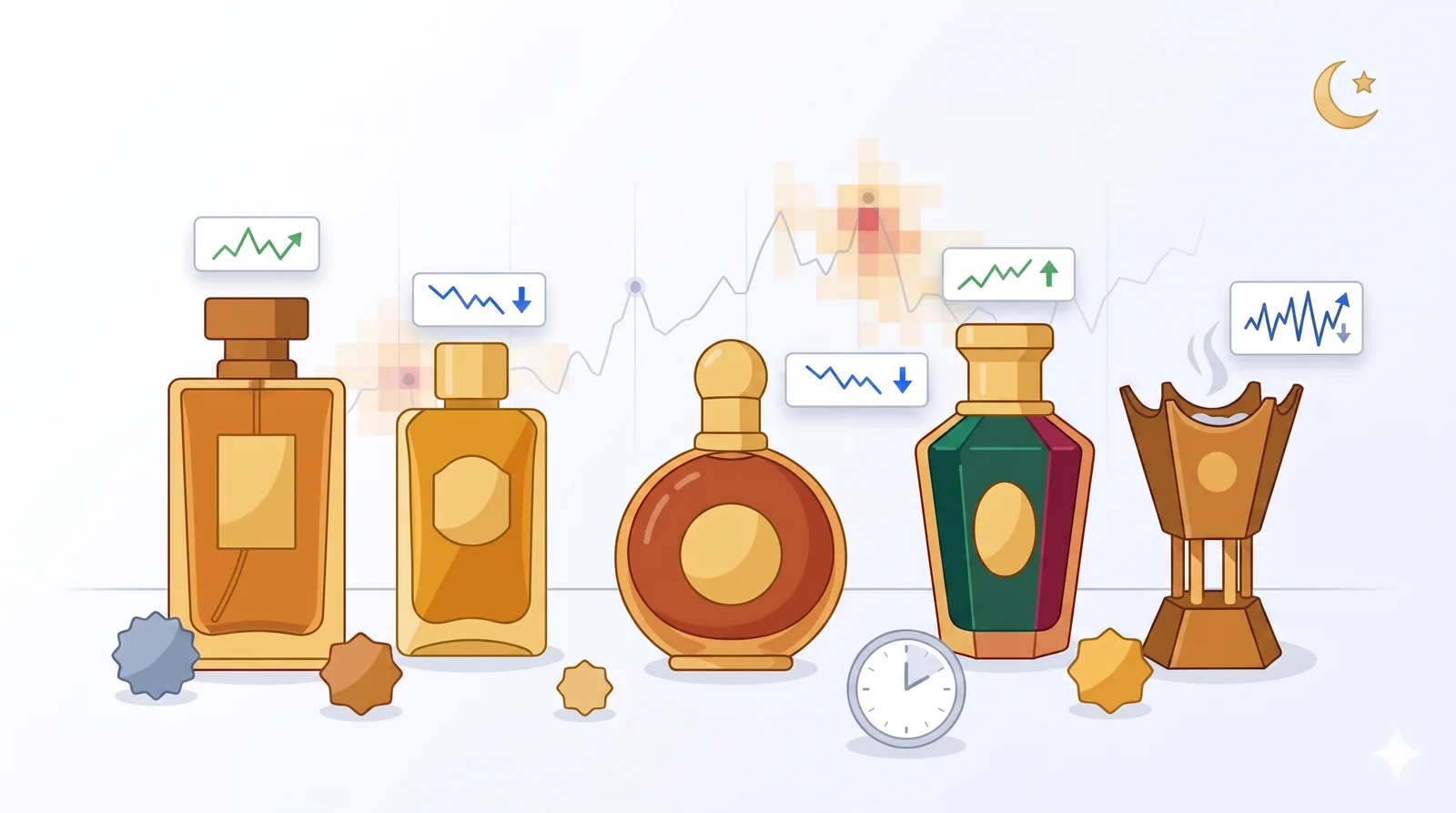
A few months ago, after the Suhoor and Iftar gatherings ended, we published a post analyzing the pricing landscape of Ramadan 2025. We revealed a fascinating trend: the season wasn't just a frenzy of wall-to-wall discounts. Instead, many savvy retailers employed a strategic playbook, often increasing prices on some products while offering deep, targeted discounts on others to drive traffic.
The response was incredible, and it left us with a new question: Does this strategic complexity hold true for the next major holiday, Eid al-Adha?
To find out, we decided to zoom in. Instead of looking at five broad categories, we focused on one of the most popular and emotionally resonant product types for Eid gifting: perfumes, oud, and fragrances. We tracked thousands of products across the MENA region from June 6th to June 11th.
What we discovered was a market that was even more dynamic and nuanced. Here's what really happened.
Finding 1: Timing is Everything, Down to the Hour
Just like in Ramadan, the idea of a simple, week-long "Eid Sale" is a myth. Price changes were not evenly distributed. Instead, they were concentrated into specific, strategic windows.
While certain days saw more activity—the day before and the first day of Eid—the most interesting pattern emerged when we looked at the clock. A significant number of price adjustments happened in the late-evening and early-morning hours (between 10 PM and 2 AM).
This suggests two things:
Automated Pricing at Work: Dynamic pricing algorithms were likely running overnight, adjusting to competitor moves, sales data from the previous day, and inventory levels. The "Flash Sale" Playbook: Retailers are using odd hours to launch limited-time flash sales, creating urgency and capturing night-owl shoppers or those in different time zones.
The takeaway: Pricing strategy isn't just about what week to run a sale, but what hour to make a move.
Finding 2: The "Magic Numbers" of Fragrance Discounts
While the most common price change was a minor fluctuation (under 5%), these are often just noise—small adjustments for currency or minor corrections. The real story is in the significant, deliberate discount points that retailers used to attract customers.
We filtered out the noise to find the most popular meaningful discount levels. These weren't random numbers; they were clear psychological anchors. The most common were:
The Go-To Tiers: 10%, 20%, and 50% were heavily used. These are familiar, easy-to-understand discounts that customers instantly recognize as good value. The Aggressive Push: We saw a surprising cluster around 68%, and even more aggressive (though less frequent) discounts at 90%. These are hyper-aggressive tactics designed to make a specific product a "hero" offer that is simply too good to ignore. The "Sweet Spot" Discounts: Numbers like 13% and 15% also appeared frequently, likely representing a standard promotional level that protects margins more than a 20% or 25% cut would.
Noticeably, the common -25% discount from Ramadan's clothing category was less prevalent here. The fragrance category plays by its own rules, favoring either standard tiers or shockingly deep cuts.
Finding 3: High Volatility and the "Hero Product" Strategy
The most telling insight was the sheer volatility. Many fragrances didn't just have one price change; their prices fluctuated multiple times throughout the 6-day Eid period.
This confirms the "hero product" strategy we hinted at in our Ramadan analysis. Here's how it works in the perfume category:
A retailer selects a popular fragrance and slashes its price with a deep, aggressive discount (e.g., -68% or more). This product is heavily marketed and becomes the traffic driver. Once customers are on the site, they are exposed to other products—perhaps a luxury oud or a premium fragrance gift set—whose prices have remained stable or even slightly increased. The profit lost on the "hero" product is more than recovered by the full-margin sales of other items in the customer's basket.
This explains the volatility: retailers were constantly adjusting prices on a select few products to win clicks and attention, while managing the profitability of their overall catalog.
Your Eid 2026 Fragrance Playbook
Based on this data, here's how you can refine your strategy for the next holiday season:
Plan by the Hour, Not Just the Day. Don't just launch your Eid campaign on day one. Consider strategic, time-sensitive flash sales during late-night hours to create urgency and stand out when email inboxes are quieter. Choose Your Discounts Deliberately. Don't just default to 25% off. For fragrances, the data suggests a tiered approach works best: Broad Appeal: Use 10% and 20% for general promotions. Deep Value: Use 50% for your key sale events. Hero Product: Don't be afraid to go deep (60%+) on one or two well-known products to drive massive traffic. Embrace Dynamic Pricing. The fragrance market during Eid is a fast-moving price war. If you're not monitoring competitor prices and adjusting yours in real-time (especially for volatile products), you're leaving money on the table. Segment Your Fragrance Portfolio. Treat your high-end, exclusive oud collections differently from your mass-market perfumes. The former has pricing power and doesn't need deep discounts, while the latter can be your "hero" product.
Stop Guessing, Start Knowing
The Eid al-Adha period is a golden opportunity for e-commerce stores, but in a competitive category like fragrances, success isn't about luck—it's about data. While your competitors are guessing their discount levels, you can be making strategic, data-driven decisions that protect your margins and maximize your revenue.
Ready to transform your pricing strategy? Visit getsampo.com to discover how our pricing intelligence platform can help your e-commerce business thrive during the most important selling seasons of the year.