Competitor Price Tracking on Salla: The DIY Wall, and the Way Around It
No price-monitoring tool connects to Salla, so most merchants end up scraping competitors themselves — and then repricing by hand, one product at a time. Why that's the real trap, and what the loop should look like instead.
You run a Salla store, and you already know the drill: a competitor drops the price on one of your bestsellers, and a few days later your sales on it quietly dry up. So you go looking for a tool that tracks competitor prices for you — the kind every Shopify merchant seems to have — and you hit a wall.
Here's the state of competitor price tracking on Salla today: the mainstream tools don't connect, so most merchants end up building their own — and even then they hit a second wall that's somehow worse than the first. This is what that looks like, and how to think about it.
The tools you'd reach for don't connect to Salla
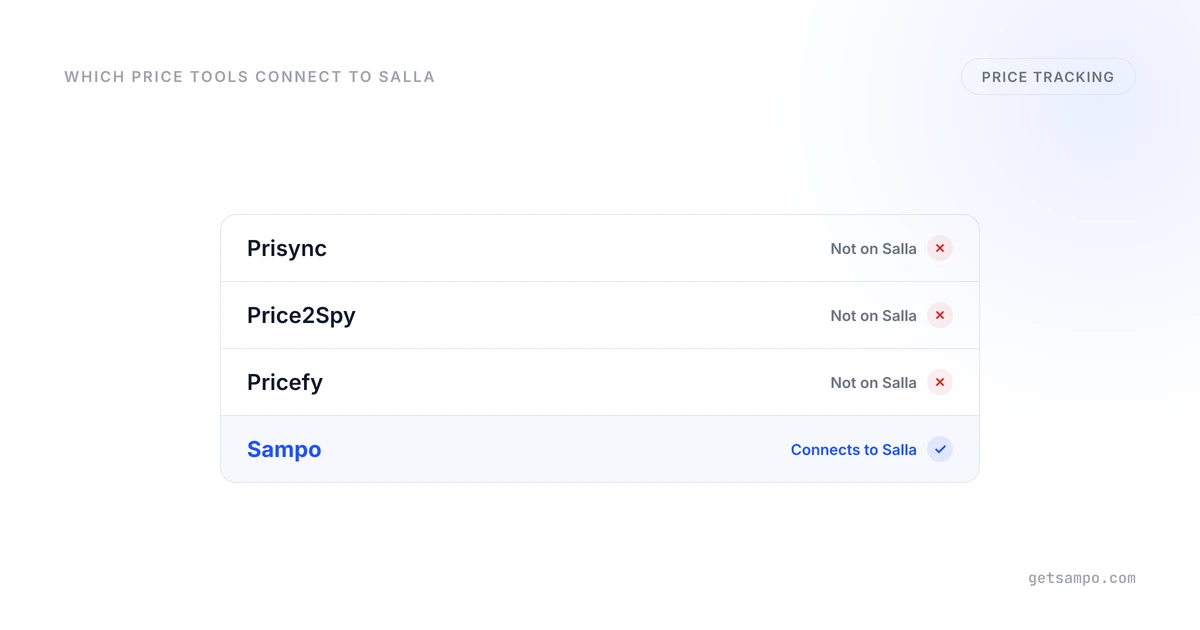
Competitor price monitoring is a mature category — Prisync, Price2Spy, Pricefy and a dozen others have done it for years. But look closely and they all integrate with the same platforms: Shopify, WooCommerce, Magento, PrestaShop. The global stack. Not Salla.
Salla is Saudi Arabia's largest e-commerce platform, but it sits outside the ecosystem the big global tools were built for — so the mainstream tracker a Shopify merchant installs in five minutes isn't one you can bolt on. And there's no crowded shelf of competitor-price apps to browse the way there is on Shopify; the category here is still young. So when the tools you'd reach for don't fit, building your own quietly becomes the default.
So you end up building a scraper
With no off-the-shelf option, the default path is to build one yourself — or ask a developer to. Point a script at each competitor, pull their prices, drop them in a sheet. For a few static sites, that's a reasonable weekend project.
It stops being reasonable fast, though. Sites change and your scraper breaks. Marketplaces like Noon and Amazon fight back with anti-bot defenses. And the hardest part isn't collecting a price — it's knowing the price you scraped is for the same product you sell, across Arabic titles, bundles, and variants. We wrote a full guide to the DIY-scraping route here — the short version is that it's more work than it looks, and it never really finishes.
Then comes repricing by hand
Say you push through all of that and you've got a clean sheet of competitor prices every morning. You're still only halfway there. Because now you have to act on it — and on Salla, that means changing your prices by hand.
Open the Salla dashboard, find the product, type the new price, save. Then the next one. Then the next. With thirty products it's a tedious morning. With two thousand SKUs whose prices should move as the market moves, it's simply not possible — you'll reprice a handful of bestsellers, the rest go stale, and most of the competitor data you worked so hard to collect never gets used.
This is the quiet trap of the DIY route: the scraping gets all the attention, but the manual repricing is what actually breaks. You end up with a dashboard full of prices you can't act on quickly enough to matter.
What it should look like instead
The loop you actually want is simple to describe: a competitor changes a price → you find out → you know what to charge → and your Salla price updates, within the margin rules you set, without anyone copy-pasting anything. Detect, decide, reprice. The data collection and the price changes are both automatic; you stay in control of the rules.
That's the whole point of a price tool — and it's exactly the part the DIY route can't give you, because a scraper produces data, not decisions, and certainly not price updates pushed back into your store.
The shortcut for Salla merchants
This gap is the reason we built Sampo to connect to Salla directly — it's the regional exception to the "global tools don't integrate" rule. It matches your catalog to competitors automatically (Arabic titles included), monitors Noon, Amazon.ae/.sa and other Saudi stores, recommends what to charge, and pushes the change back to your Salla store on rules you control. No scraper to maintain, no prices to retype.
We mention it because it's what we make — but the test is the loop above: if you can detect a competitor move and have your Salla price respond the same day without manual work, you've solved it, whoever you use.
The takeaway
Tracking competitor prices on Salla is harder than it is on Shopify, for one structural reason: the mainstream tools skip the platform. That leaves you scraping, and then repricing by hand — two jobs that each look small and turn out not to be. If you only have a handful of products and a developer with spare time, the DIY route is fine. Past that, the manual work is the real cost, and the maths usually favours letting something connect to Salla and close the loop for you.
Monitor competitor prices, stock, and promotions hourly with products matched to your catalog.