Competitor Price Tracking on Zid: Why Building Your Own Hits a Wall
The competitor-price tools don't integrate with Zid, so the default is to build a scraper. But the scraping was never the hard part — updating your prices by hand, one SKU at a time, is the wall. Here's the full picture.
It usually starts with a reasonable-sounding request. You run a growing Zid store, you want to keep an eye on competitor prices, so you ask your developer to "just scrape a few competitors." Three weeks later you have a working script, a folder of CSVs — and a problem nobody flagged at the start.
The reason it gets to that point is the same one every Zid merchant runs into: the mainstream competitor-price tools don't connect to Zid, so building your own feels like the only option. It's not a bad instinct. It's just that the scraping was never the hard part. Here's the full picture.
Why the usual price tools don't fit Zid
Competitor price monitoring is a crowded category — Prisync, Price2Spy, Pricefy and plenty more. Every one of them, though, is built around the global platforms: Shopify, WooCommerce, Magento. Zid isn't on their list. And the Zid Market doesn't carry the same deep bench of price-tracking apps you'd find on Shopify — the category is only just emerging here — so when the tools you'd reach for don't connect, building your own feels like the obvious move.
Zid powers a fast-growing share of Saudi and Gulf brands, but it grew up outside the ecosystem these tools were written for. So unlike a Shopify merchant, you can't just connect an app — which is exactly why "ask the developer to build something" becomes the default.
The scraper is the easy 80%
And a developer can absolutely build a scraper. Fetch each competitor's page, pull the price, store it. For a handful of stable sites it's a few days of work and it feels solved.
Then the long tail arrives. Competitors redesign their pages and the script silently breaks. Noon and Amazon throw up anti-bot walls. And the genuinely hard part — matching a scraped listing to the right product in your own catalog, across Arabic and mixed-language titles, variants and bundles — is the part that never stops needing attention. We broke the whole DIY route down here; the summary is that the maintenance is the product.
Repricing is the real wall
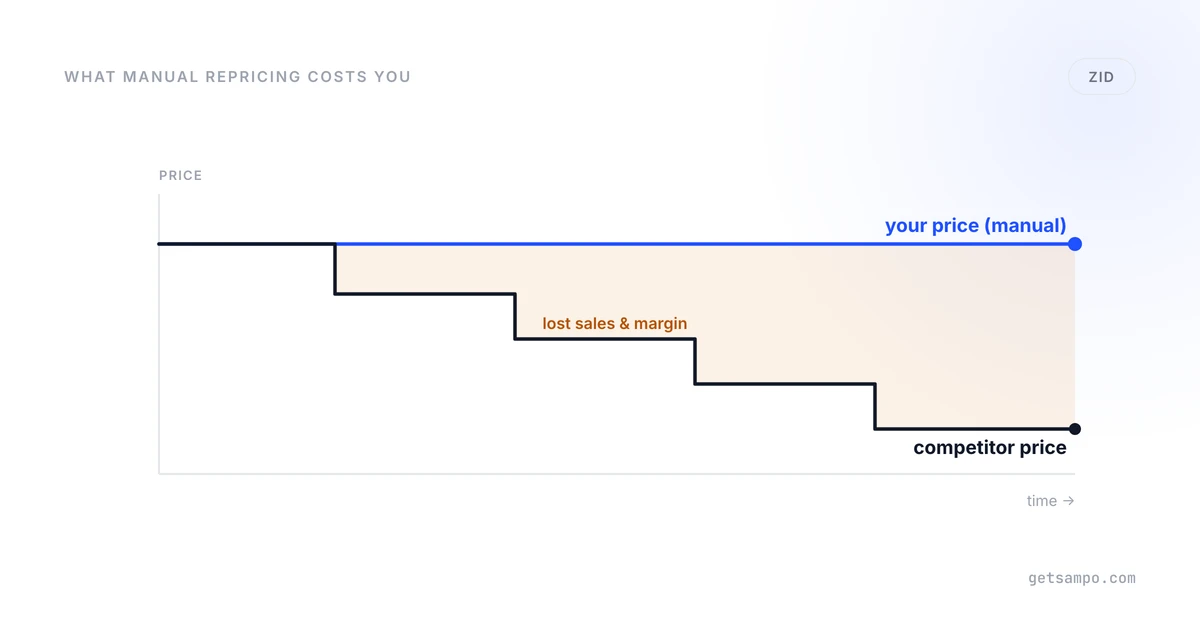
Here's the part that catches teams out. Suppose the scraper works perfectly and every morning you've got fresh competitor prices. You still have to do something with them — and on Zid, that means editing your prices one product at a time.
Someone opens the Zid dashboard, finds a product, updates the price, saves, and moves to the next. It's fine for a short list. For a real catalog — hundreds or thousands of SKUs, with competitor prices that move daily — it's a treadmill you can't keep up with. The data your developer worked to collect ages faster than anyone can apply it, so most of it just sits there.
Which is the irony of the DIY approach: the engineering goes into the scraper, but the thing that actually limits you is a human retyping prices into Zid. You can scrape the whole market and still only reprice the ten products someone had time for this week.
The loop you're actually trying to build
Strip it back and the goal is a closed loop: a competitor moves → you're alerted → you know the right price → your Zid store updates automatically, inside the margin limits you've set. Detect, decide, reprice — with the collection and the changes both handled for you, and you owning the rules.
A DIY scraper can only ever deliver the first step. It hands you data; it can't tell you what to charge, and it certainly can't push a new price back into Zid. The two ends of the loop — the decision and the update — are the ones that take the manual work, and they're the ones worth automating.
The shorter path for Zid stores
Closing that gap is why Sampo connects to Zid directly — the regional exception to the rule that the price tools skip the platform. It auto-matches your catalog to competitors (Arabic included), watches Noon, Amazon.ae/.sa and the stores your buyers actually compare against, recommends the move, and writes the new price back to Zid on rules you set. No scraper to babysit, no dashboard data-entry.
It's our product, so take the pitch with the appropriate salt — but the benchmark is the loop: if a competitor's price can change and your Zid price can respond the same day without anyone editing products by hand, you're done, whatever tool gets you there.
The bottom line
On Zid, competitor price tracking runs into the same structural wall every time: the usual tools don't connect, so you build, and then you hit the repricing by hand. The scraper is the part everyone budgets for; the manual repricing is the part that quietly decides whether any of it was worth doing. For a few products it's manageable. At any real scale, the work that matters is the work you can't do one row at a time.
Monitor competitor prices, stock, and promotions hourly with products matched to your catalog.