From Perishable to Profitable: The E-commerce Playbook for Zero Waste
For any e-commerce business selling fresh food, baked goods, or other perishables, the storeroom is a place of constant tension. It's the daily dilemma captured in a single question: Should I order five boxes of bananas, or ten?
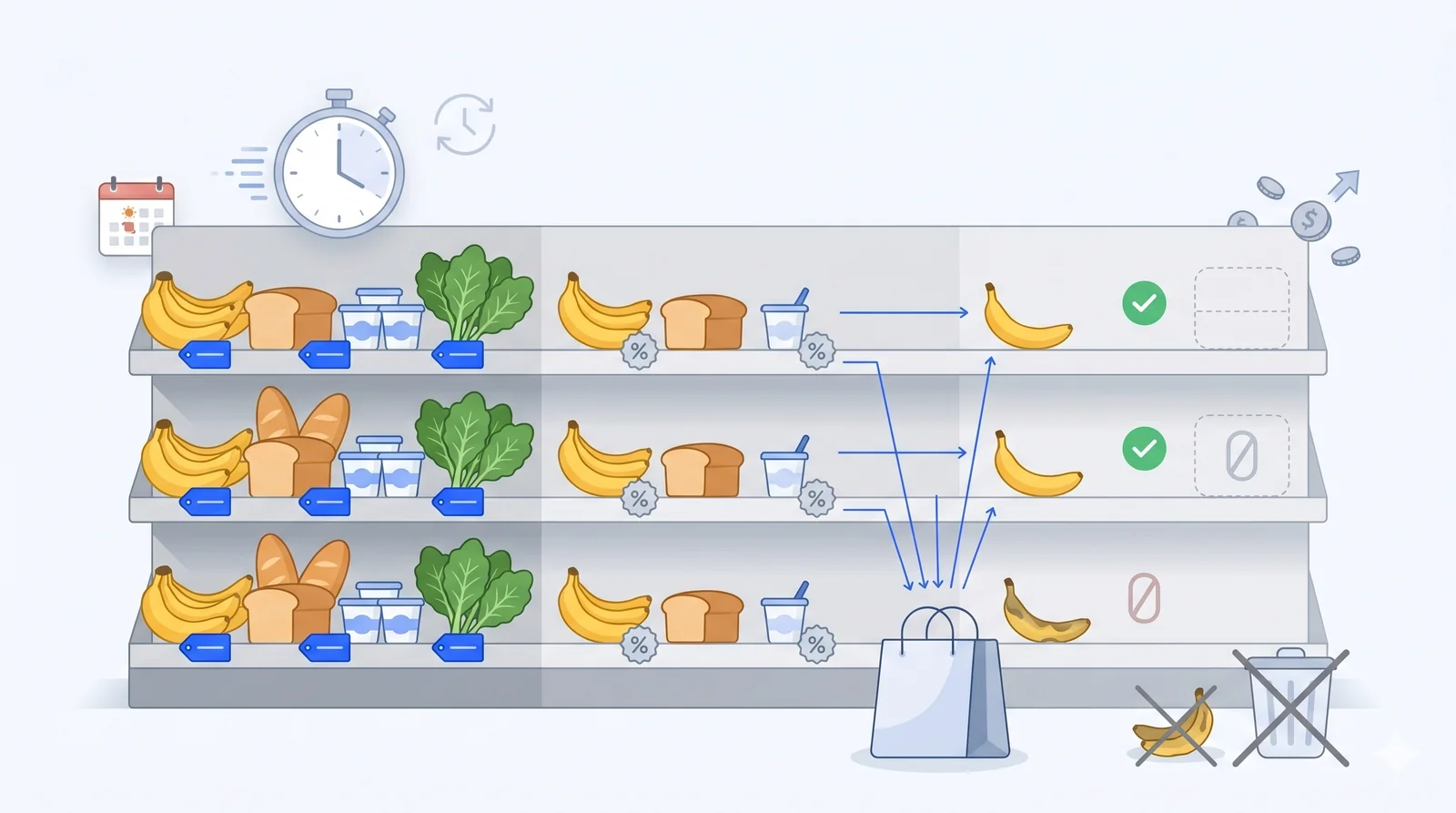
For any e-commerce business selling fresh food, baked goods, or other perishables, the storeroom is a place of constant tension. It's the daily dilemma captured in a single question: Should I order five boxes of bananas, or ten?
Order five, and you risk selling out, disappointing customers and losing sales. Order ten, and you risk that familiar, sinking feeling at the end of the week—staring at perfectly good products that are now unsellable.
This isn't just waste. It's profit, literally being thrown in the bin.
For too long, the industry has accepted this as a cost of doing business. The strategy has been a high-stakes guessing game:
Forecast based on instinct: Use historical data and a bit of hope to place inventory orders. React with panic: When expiration dates loom, resort to a last-minute, steep discount ("50% Off - Must Go Today!") or, worse, absorb the total loss.
This cycle is not only stressful, but it directly erodes your bottom line. But what if you could move from this reactive gamble to a proactive, automated system that ensures every item sells before it expires?
The New Playbook: Turning Expiration Dates into Revenue Triggers
The solution isn't to get better at guessing. It's to use data to eliminate the guesswork entirely. Here's a smarter, three-step approach to managing perishable inventory.
Step 1: Know Your Sales Velocity, Not Just Your Stock Levels
The first step is to shift your focus from "what I have" to "what I will sell." Instead of looking at 100 bananas in your inventory, you need a precise answer to a more important question:
Given my current sales patterns and this product's expiration date, how many of these 100 bananas am I predicted to sell before they expire?
Data can provide this answer. By analyzing sales velocity and customer behavior, you can generate a reliable forecast. Suddenly, the problem becomes clear. You have 100 units, but you're on track to sell only 60. You now have a known, quantifiable problem: a predicted surplus of 40 units.
Step 2: Turn the Expiration Date into a Deadline for Action
An expiration date shouldn't be a finish line where your product becomes worthless. It should be a deadline that triggers a smart, automated strategy.
With your predicted surplus of 40 bananas, and knowing they expire in seven days, you have a clear mission: sell an extra 40 units within one week. Waiting until day six to take action is too late. The key is to start early and be subtle.
Step 3: Automate a Smart "Sell-Down," Not a Panic "Sell-Off"
Instead of a drastic, last-minute price slash, you can implement a gradual, automated sell-down strategy. Here's how it works with our banana example:
The Goal: Sell the 40-unit surplus over 7 days. Day 1: The system detects the predicted surplus. It automatically applies a small, gentle discount—perhaps just 5% or 10%. This slight price drop is enough to nudge demand and start moving a few extra units. Day 3: The system re-evaluates. Are you now on track to sell all 100 units? If not, it might increase the discount slightly to 15%. Day 5: It continues to monitor and adjust, increasing the incentive as the deadline approaches, but only as much as is necessary.
The result? You sell all 100 bananas before they expire. You've boosted demand just enough to clear the inventory, capturing far more revenue than a last-minute 50% off sale ever could, and completely avoiding the cost of waste.
The Impossible Task: Doing This for Thousands of SKUs
This strategy is brilliant for one product. But what about the milk, the yogurt, the fresh bread, the packaged salads, and the hundreds or thousands of other items in your store, each with its own expiration date and sales velocity?
Manually tracking every single SKU, calculating its predicted surplus, and adjusting its price daily is a logistical nightmare. It's impossible. You can't be a pricing analyst for every loaf of bread and carton of eggs.
This is where intelligent automation becomes non-negotiable.
This is exactly what Sampo was built to do. Our platform acts as your automated inventory and pricing strategist.
Demand Forecasting: Sampo analyzes your sales data to predict how many units of each item you will sell before its specific expiration date. Surplus Identification: Our system automatically identifies products that are on track to have a surplus. Automated Sell-Down: Sampo can execute an "Expiry-Driven Pricing" strategy, automatically applying small, gradual discounts to at-risk products to ensure they sell out before their deadline.
We turn the complex, impossible task of manual management into a seamless, automated process that works for you 24/7.
Stop throwing your profits in the bin. It's time to transform your biggest inventory liability into a powerful and predictable revenue stream.
Ready to eliminate waste and maximize revenue? Discover how Sampo's expiry-driven pricing can protect your bottom line.
Apply pricing rules to selected products using competitor data and minimum prices you configure.